3D Printing vs. Injection Modelling: The Economic Break-Even Point
3D printing requires no upfront tooling cost, making it highly economical for low-volume production under 1,000 units. Injection molding becomes cheaper for larger runs where high tool costs are amortized.
Sourcing Low-Volume Plastic Parts
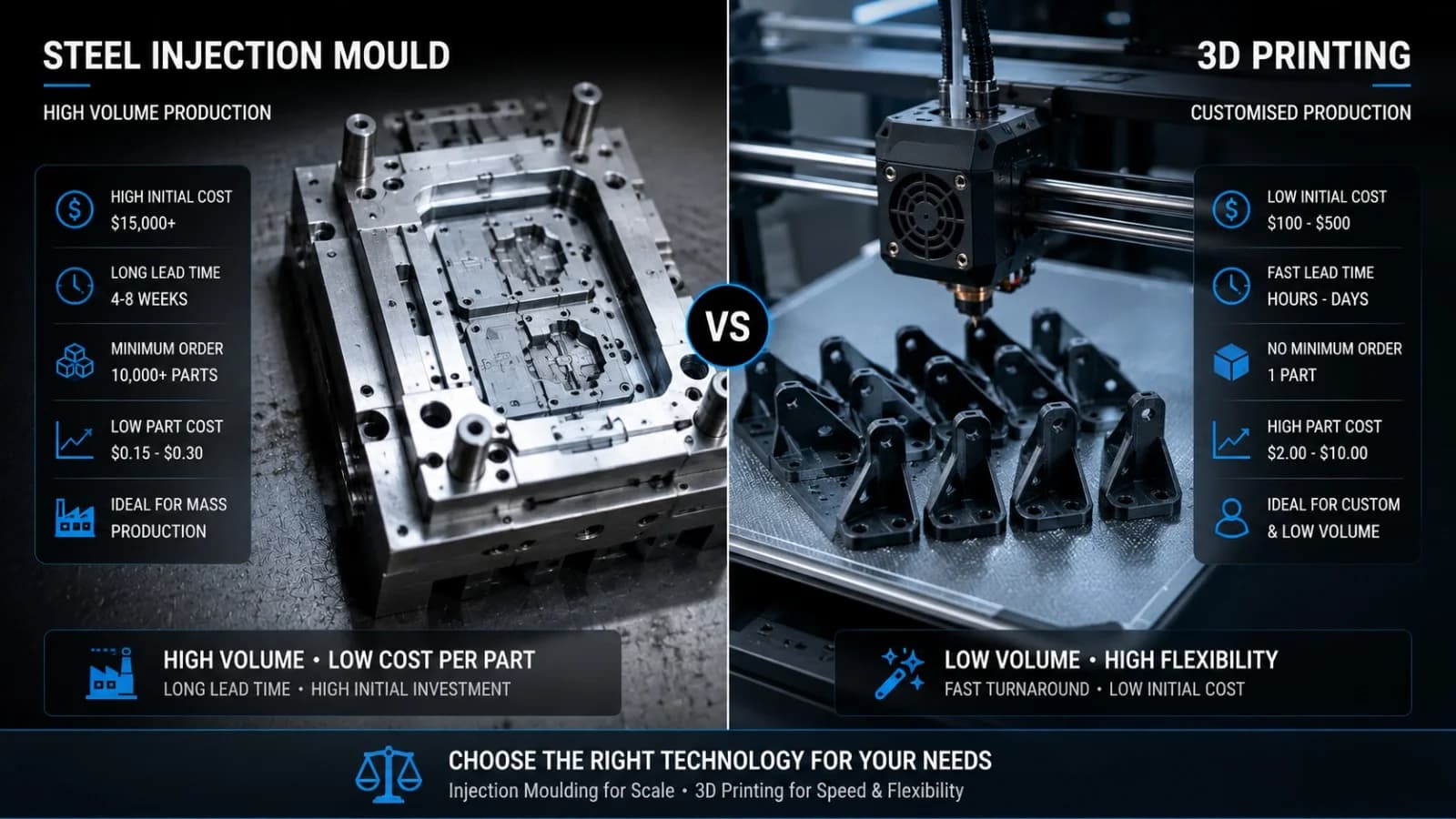
For product developers, the path to manufacturing is defined by economics. When you need custom plastic components, the traditional default is injection moulding. However, injection moulding requires high up-front capital investment to design and cut metal tools (moulds), which often cost between £3,000 and £20,000.
3D printing requires zero tooling. You pay only for the machine runtime and material used. But when does 3D printing make financial sense, and where is the break-even point?
For batch sizes under 500 to 1,000 parts, 3D printing is almost always more cost-effective and faster than injection moulding because it avoids high tooling costs.
`
Cost Per Part Comparison (Conceptual)
^
| / [Injection Moulding (Tooling + Part Cost)]
| /
|/
|------------------------------------- [3D Printing (Flat Cost)]
|
+---------------------------------------------> Volume
`
The Cost Structures Compared
- Injection Moulding: Has a very high initial setup cost (tooling), but a very low cost-per-part once the mould is running.
- 3D Printing: Has a setup cost of near zero, but a flat cost-per-part that does not decrease significantly with volume.
Finding the Break-Even Point
The exact volume where injection moulding becomes cheaper than 3D printing depends on the part size, geometry, and material:
- Very Small, Complex Parts (e.g. custom gears, brackets): The tooling is complex, but the print time is short. The break-even point is often around 500 to 1,000 units.
- Large Enclosures (e.g. console housings): Large injection moulds are extremely expensive. 3D printing remains more economical for volumes up to 200 units.
- Highly Customised Parts: If each part needs a unique serial number or custom sizing, injection moulding is impossible. 3D printing is the only viable option.
Additional Factors to Consider
- Lead Time: Injection tooling takes 4 to 8 weeks to manufacture. 3D printing can begin within hours of CAD approval.
- Design Freedom: Injection moulding requires draft angles, uniform wall thicknesses, and no undercuts. 3D printing has far fewer geometric restrictions, allowing you to combine multiple parts into a single printed component.
Small Batch Production in Yorkshire
At NovaLab 3D, we help businesses bridge the gap between prototyping and mass production with small-batch FDM runs of up to 500 parts. Contact Keagan Walker to request an economic analysis of your production run.
Frequently Asked Questions
Keagan Walker
Founder & Lead Designer
NovaLab 3D is a boutique engineering and additive manufacturing studio based in Pickering, North Yorkshire. We provide B2B clients and product developers with direct access to lead engineering consulting, fast 48-hour turnarounds, and custom FDM production runs.