A Design Guide to Bosses and Ribs in Additive Manufacturing
Standard injection-molding rules for thin ribs do not apply to FDM. Designing structural ribs and thicker bosses prevents part failure and layer shearing.
Structural Optimization in CAD
When designing plastic enclosures, structural brackets, or mounting plates, designers often attempt to make parts stronger by increasing wall thickness. In FDM printing, thick solid walls are inefficient: they require massive infill, consume excess material, increase print times, and are highly prone to warping and shrinking.
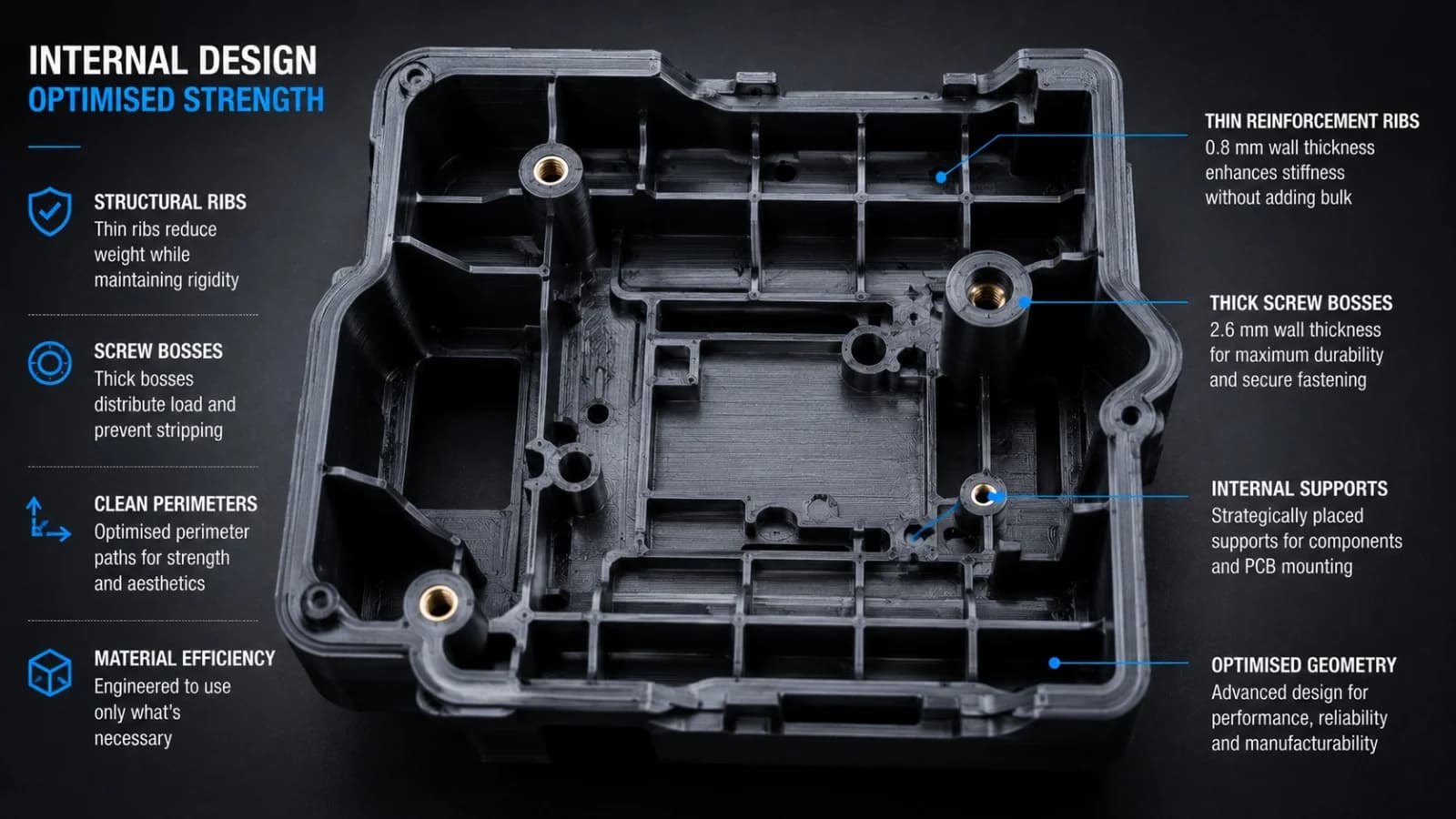
The professional solution is to keep wall thicknesses thin and uniform, and use structural ribs and screw bosses to provide rigidity where it is needed.
Incorporating gussets and ribs into your CAD models increases structural bending strength by up to 300% without increasing the print weight or material cost.
1. Structural Ribs: Defeating Bending Forces
A rib is a thin, perpendicular wall that runs along the length of a flat surface to prevent it from flexing or bending.
- Rib Thickness: Design ribs to be 50% to 60% of the thickness of the main wall. If a wall is 3mm thick, the rib should be 1.5mm to 1.8mm.
- Rib Height: The height of the rib should be at least 3 times the main wall thickness.
- Add Draft Angles: Add a slight angle to the sides of the rib to help the printer deposit the perimeters smoothly.
2. Gussets: Strengthening Corner Joints
A gusset is a triangular rib that supports a 90-degree corner intersection. Without a gusset, a corner joint behaves like a lever arm, magnifying forces that can easily tear the print layers apart.
- Design gussets on both sides of a corner joint.
- Keep the gusset's thickness matching the rib guidelines.
3. Bosses: Designing Screw Mounts
A boss is a cylindrical column designed to accept screws or threaded inserts.
- Boss Diameter: The outer diameter of the boss should be at least 2 times the bolt diameter.
- Connect to Walls: Never let a mounting boss stand alone in the middle of a thin enclosure wall. Always connect the boss to the nearest side wall with a structural rib (gusset) to distribute fastener torque forces.
Professional Geometry Audits
NovaLab 3D provides full CAD review services for product designers and B2B clients. We can identify weak walls and suggest optimal rib placements to make your printed parts stronger. Submit your STEP files today.
Frequently Asked Questions
Keagan Walker
Founder & Lead Designer
NovaLab 3D is a boutique engineering and additive manufacturing studio based in Pickering, North Yorkshire. We provide B2B clients and product developers with direct access to lead engineering consulting, fast 48-hour turnarounds, and custom FDM production runs.