Dimensional Accuracy and Shrinkage in FDM Engineering Filaments
Different thermoplastics contract at different rates as they cool. Compensating for material-specific shrinkage in your CAD file ensures high dimensional accuracy.
Compensating for Thermal Physics in Printing
FDM 3D printing is a thermal process: thermoplastic is heated to a molten state, extruded, and then cooled to room temperature. A basic law of physics dictates that most materials expand when heated and contract (shrink) when cooled.
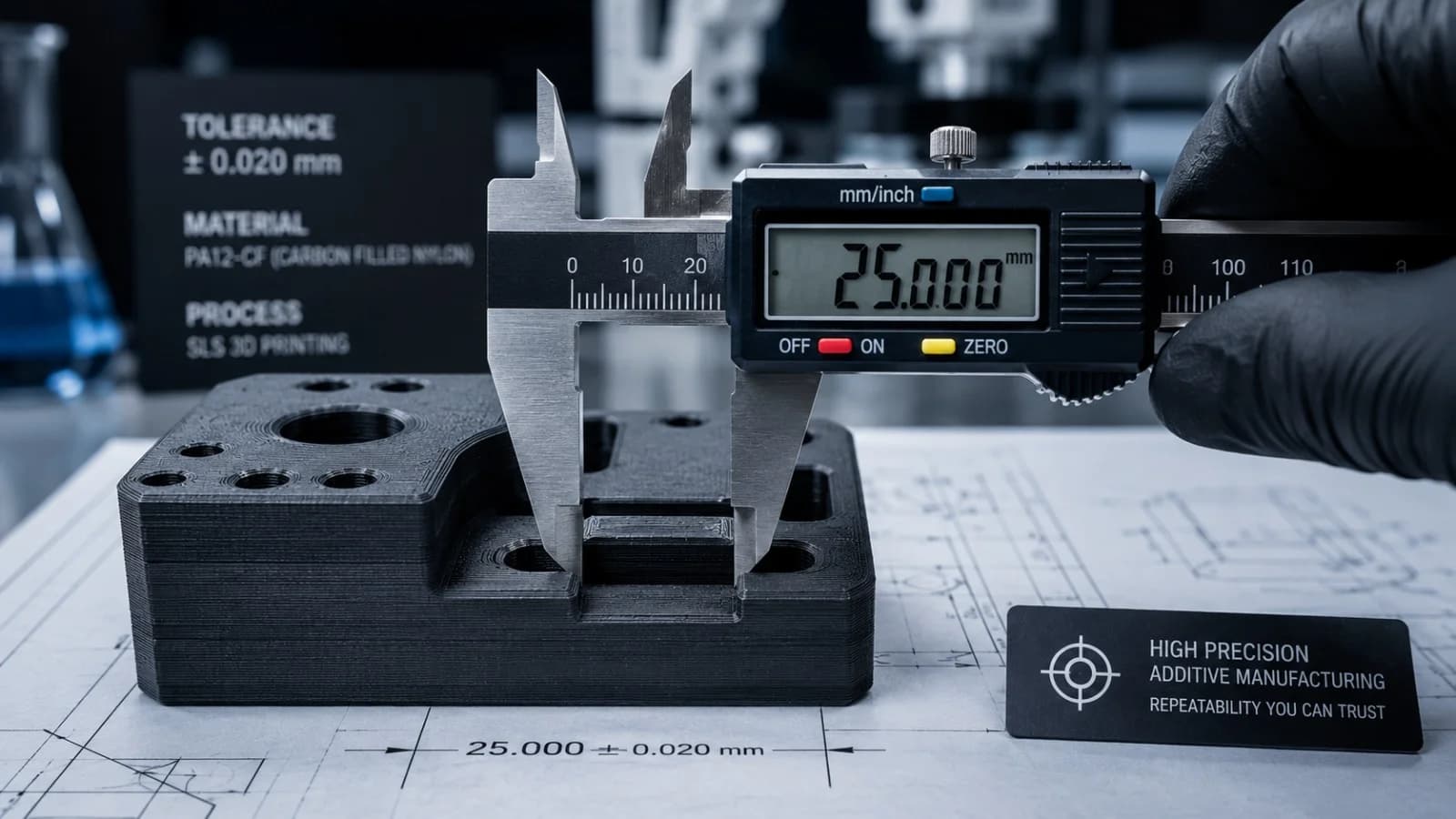
For cosmetic parts, a 1% shrinkage is unnoticeable. For high-precision engineering parts, such as bearing housings, gears, and mating electronics boxes, a minor shrinkage error will render the part useless.
Different polymers have different shrinkage rates. We apply material-specific scaling factors in our slicers to ensure your parts match the exact dimensions of your CAD files.
Shrinkage Rates of Common Filaments
We monitor and calibrate for the distinct shrinkage factors of each material at our Pickering facility:
- PLA: Very low shrinkage (around 0.1% to 0.2%). Highly accurate and stable, making it the easiest material for large assemblies.
- PETG: Low to moderate shrinkage (around 0.2% to 0.4%). Generally holds dimensions well but requires calibration on large volumes.
- ABS / ASA: High shrinkage (around 1.0% to 1.5%). These materials contract heavily as they cool. Without a heated build chamber, they will warp off the bed and shrink undersize.
- Nylon (PA): Very high shrinkage (up to 2.0%). Nylon is highly prone to thermal deformation and must be printed under strict temperature controls.
How We Calibrate for Precision
To guarantee ±0.1mm tolerances for engineering clients, we combine several calibration techniques:
- Dimensional Scaling: If a material shrinks by 1.2%, we scale the model to 101.2% in the slicer prior to printing.
- Active Temperature Management: We print high-shrinkage materials in enclosed chambers heated to 50°C-70°C to slow down the cooling rate, allowing the polymer to settle before contracting.
- Horizontal Expansion Compensation: Slicers can adjust the inner and outer diameters of vertical walls to compensate for filament squish. We run test cards to calibrate these settings for every batch of filament we purchase.
Precision Engineering Parts
Need a part printed to precise mechanical tolerances? Partner with NovaLab 3D. We perform test runs and calibrate scaling factors for every high-precision project. Request a quote today.
Frequently Asked Questions
Keagan Walker
Founder & Lead Designer
NovaLab 3D is a boutique engineering and additive manufacturing studio based in Pickering, North Yorkshire. We provide B2B clients and product developers with direct access to lead engineering consulting, fast 48-hour turnarounds, and custom FDM production runs.