Optimising Infill Density and Patterns for Maximum Strength
Choosing the right infill pattern (like Gyroid) and density optimizes part strength, weight, and print time. Adding perimeters is often more effective than increasing infill density alone.
The Internal Structure of 3D Prints
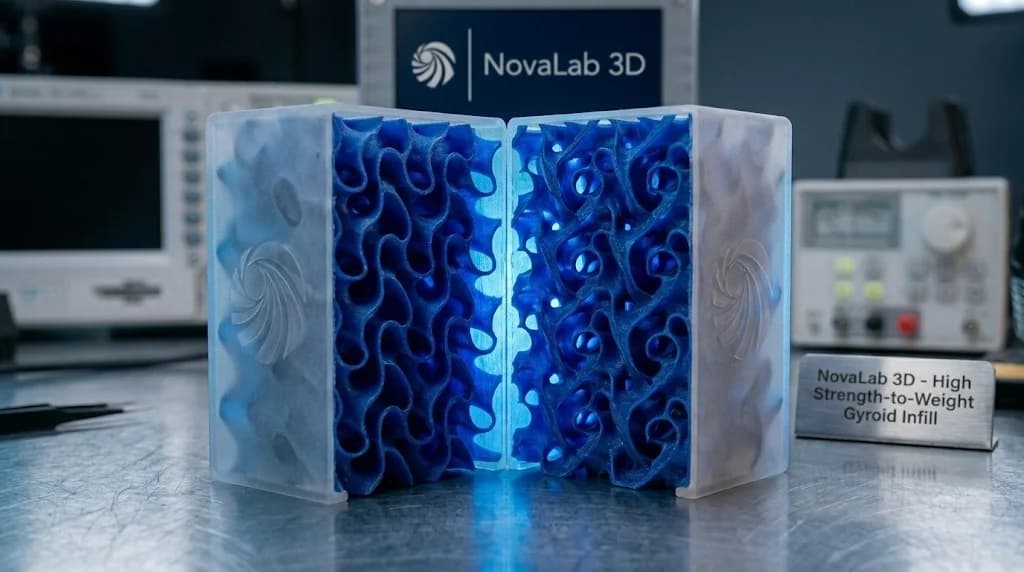
Unlike injection-moulded parts, which are completely solid plastic, FDM 3D prints are typically printed with a solid outer skin (perimeters) and a hollow, patterned internal structure known as infill.
Managing infill settings is a powerful way to optimise a part: it allows you to reduce material usage, save weight, and speed up print times while maintaining structural integrity. However, choosing the wrong infill pattern or density can lead to premature part failure under load.
To maximise mechanical strength, increase wall perimeters rather than infill density, and use a 3D isotropic pattern like Gyroid to resist stress from all directions.
1. Infill Density vs. Wall Perimeters
A common mistake is increasing infill density to 80% or 100% to make a part stronger. In engineering, this is highly inefficient.
- The Outer Shell Matters Most: The outer walls (perimeters) carry the majority of the tensile and bending stress in a component.
- The Golden Rule: If you need a part to withstand higher loads, increase the perimeter loop count (e.g. from 2 to 5 walls) instead of infill. A part with 5 perimeters and 20% infill is often stronger and lighter than a part with 2 perimeters and 80% infill.
2. Choosing the Right Infill Pattern
Different infill patterns distribute forces in different ways. We match the pattern to the application:
- Gyroid (Recommended): An organic, wavy 3D pattern that provides equal strength in all directions (isotropic). It prints quickly, uses material efficiently, and is highly resistant to shear forces.
- Grid / Rectilinear: Excellent for parts that only experience compression forces along a single axis. However, they are prone to cracking under multi-directional forces.
- Honeycomb: Extremely strong, but uses more material and takes longer to print because of the constant nozzle direction changes.
Optimize Your Part Weight and Cost
At NovaLab 3D, we perform structural analysis on your parts to determine the ideal infill pattern and wall perimeters. Let Keagan Walker optimize your CAD files for the best balance of strength, weight, and printing cost. Upload your files today.
Frequently Asked Questions
Keagan Walker
Founder & Lead Designer
NovaLab 3D is a boutique engineering and additive manufacturing studio based in Pickering, North Yorkshire. We provide B2B clients and product developers with direct access to lead engineering consulting, fast 48-hour turnarounds, and custom FDM production runs.